
Introduction
Stray Light Analysis
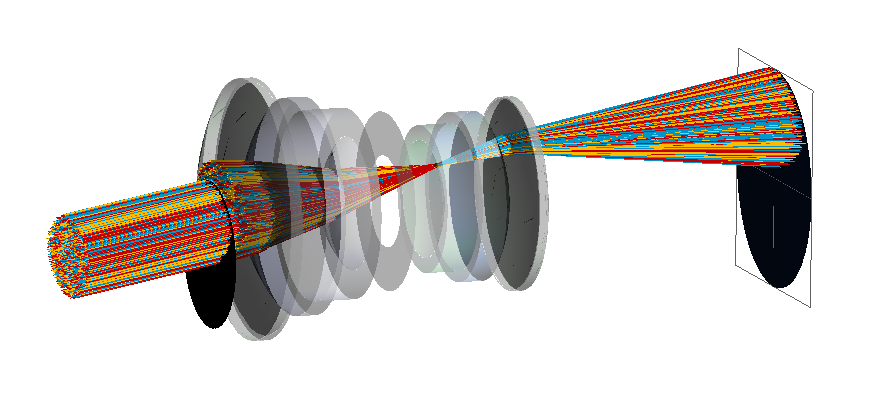
Stray light is the presence of unintended (and generally unwanted) light paths in your optical system which become a source of noise in the measured optical signal. These paths can be generated by events such as scattering from optical or mechanical surfaces and/or ghost paths (reflections from nominally transmissive surfaces).
FRED’s powerful suite of tools has been developed over multiple years to make it simple to find these paths - making FRED an indispensable tool for Stray Light Analysis.
This article discusses several FRED features to simulate and identify Stray Light in your system including:
- • Detailed Raytrace Controls
- • How to generate ray paths
- • The Raytrace Paths Report
- • Filtering with Ray Filters and the ‘Analysis Lasso’ filter
- • The Stray Light Report
Read our 3-part series here
The NASA Terrestrial Planet Finder (TPF)
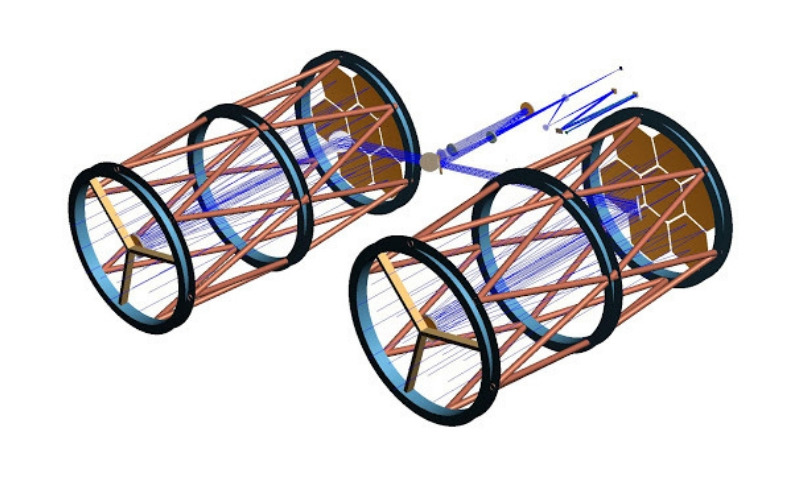
A space-based telescope for detecting planets around stars. It is a multi-telescope, interferometric system where the star image is nulled out, revealing the planet.
Particle contamination levels increase with time sensitivity degrades over the operational lifetime of the instrument.


Demonstration of Principle
Left: Simulation model of the system. Light enters the system from two telescopes. One path has a phase plate.
- (A):Using direct imaging, only the image of the star can be seen.
- (B):When the phase plate is adjusted to null the star image, the planet can now be clearly seen
 (A)
(A)
 (B)
(B)
Performance Degradation Due To Scatter
In the actual hardware, at least 2 scatter mechanisms will be present on the primary and secondary mirrors:
-
Surface roughness:
- - 20Å rms. Total integrated scatter (TIS) = 0.0006%.
-
Particulate contamination:
- - Mirror surfaces are covered according to MIL-STD-1246 distribution.
- - Two levels were evaluated: CL400 (0.1%) and CL600 (1.0%).


Simulation Results
Observe a planet orbiting a bright star

No surface roughness, no contamination
 Star and orbiting planet
20Å rms roughness, 0.1% contamination
 Reduced contrast
20Å rms roughness, 1.0% contamination
 Image is destroyed
Stray Light Analysis of the Large Synoptic Survey Telescope (LSST)
The Large Synoptic Survey Telescope (LSST) at the Rubin Observatory is a large, ground-based telescope that can survey the entire sky every three nights to construct a detailed map of the universe while searching for faint and moving objects (www.lsst.org).
FRED was used to study the initial proposed design and identified stray light mechanisms that required unique baffling approaches.


The FRED Optical Model
In order to be effective, computer modeling of telescope systems must be accurate and sufficiently detailed.
In the FRED model the mirrors have a silver coating with 94% average reflectivity and Harvey Shack scatter models for surface roughness.

- • A Mie particle model was also used for contamination using the EST-STD-1246D distribution model.
- • The optical filters use an anti-reflective coating with an average reflectivity less than 1.5%. The specular reflectivity of the CCD detector is set to be 18%.
- • Non-optical surfaces were assigned a Black Paint scatter model for Aeroglaze Z306
Stray Light Analysis Results
“PST” Point Source Transmittance
A PST calculation is a calculation for analyzing the stray light of a system. It is defined as the total power at the detector divided by the total light entering the system.
The PST was calculated for telescope orientation of 0 - 80 degrees (b), and for 5 different azimuth angles. The results (c) showed 3 distinct causes of stray light.
- (i) 2 - 10 deg: Surface roughness from the primary and secondary mirrors
- (ii) 10 - 40 deg: Scatter from the baffles and other non-optical surfaces
- (iii) 40 - 80 deg: Scatter from the dome above the telescope
.png) (a)
(a)
 (b)
(b)
 (c)
(c)
About Photon Engineering
Founded in 1997 Photon Engineering is an optical engineering software and consulting firm, and are the creators of industry-leading raytracing software FRED.
CBS Japan is the exclusive distributor of FRED in Japan.